Is your product page agent-ready? What BCG's research says, and the part it leaves out: your photos


AI agents now build the shortlist before anyone visits a product page. Product visuals arethe part of the digital shelf most retailers still overlook.
Key takeaways
- AI agents now build the shortlist before shoppers ever see a product page.
- Agent readiness is being framed as a data project. Product images are its blind spot.
- Images carry the proof. Retailers that set visual standards, and get vendors to meetthem, give agents more reasons to pick their products.
A shopper asks an AI assistant to reorder household basics, find a birthday gift under $50and check whether a pair of shoes has dropped in price. Thirty seconds later, all three arehandled. No webpage visited, no banner seen. That's the scenario BCG opens its latestretail research with, and it's closer than most retailers think.
Most agentic commerce advice stops at data feeds and catalog attributes. It overlookswhat does the most work for shoppers: the images.
At Nfinite, we analyze product visuals on retailers' digital shelves every day. Here's whatthe research means for them.
Agents now read the shelf before shoppers do
Agentic commerce is early, but the direction is clear. According to BCG, 80% of US consumers already use AI, and nearly half of them use it to shop. About 70% of those AI shoppers use it to compare product attributes. By 2030, more than half of e-commerce spending could be agent-assisted.
The traffic is already the most valuable a retailer gets. ECDB's analysis of Adobe and Similarweb data puts the conversion rate of visits referred by ChatGPT at 11.4%, or 54% above non-AI traffic. Meanwhile, 60% of searches now end without a click, per ECDB.
Retailers know it, and most aren't ready. BCG surveyed 50 of the top 300 global retailers: only 18% consider their marketplace ready for agents. Their two-year roadmaps start with data. 67% plan to enrich product data, 58% to provide real-time availability and 45% to raise seller data quality.

The logic is simple. An agent can only recommend what it can find, and it can only findwhat it can understand.
Product images are product data
When the conversation turns to "product data," most teams think of attributes, prices and stock levels. But on the digital shelf, images carry product information too. Each one has a job:
- Identify the exact product and variant.
- Show scale, so the shopper understands size in context.
- Prove the details: material, finish, connectors, texture.
- Show use: how the product works and where it fits.
- Show what's included, before the shopper has to ask.
When one of those jobs isn't done, there's a gap. Across the shelves we analyze, the same visual gaps come back again and again:
- One image doing the work of five. A single packshot for a product that needs a detail view, a scale shot and an in-use shot.
- Variant mismatches. The blue SKU shows the black product, or every color shares the same photo.
- Facts locked in pixels. Dimensions or compatibility printed on an infographic and missing from the attributes.
- Images described generically. "Image 1" file names, or the same alt text on every photo.
- No consistency across vendors. Different angles, backgrounds and image counts in the same category make products hard to compare.
Take a bathroom vanity with four photos: the unit in a tiled bathroom, a close-up of the drawers, the matching tall cabinet in two finishes, and the vanity next to a towel ladder. To a shopper, those photos answer real questions. Is it oak? What color are the handles? Will it fit? Is there matching storage?
Now imagine every photo is labeled "Bathroom vanity unit," the dimensions only appear on a drawing, and the anthracite finish isn't listed as a variant. The proof is all there. It just isn't in a form an agent comparing three vanities can reliably use.

Our take: these gaps matter more in an agent world. Agents compare what they can reliably interpret, so a spec that only lives in a photo may never be compared. And a"matte black" listing with a chrome photo becomes a risky recommendation.
The stakes are highest where shoppers compare specs before buying. BCG found that 59% of household appliance shoppers are research-led, against 42% in skincare. Furniture, tools and home improvement are just as spec-heavy. That's where photos carry the most proof, and where visual gaps cost the most.
Three places your visuals now get judged
BCG argues that retailers now play two games. The evaluation game is about winning the agent's recommendation. The destination game is about giving shoppers a reason to come directly. Product visuals sit at the center of both, in three moments.
1. The agent's shortlist. External agents evaluate retailers on product data, prices, availability, delivery, returns and offers they can interpret. Content that is incomplete or contradictory gives the agent fewer reasons to pick your product.
2. The landing page. AI traffic arrives pre-qualified, which is why it converts best. BCG adds that agent-referred shoppers arrive with higher intent and browse less. They're not exploring, they're confirming the agent's choice. The images have seconds to do that.
3. The retailer's own agent. Walmart's Sparky, Lowe's Mylow, Amazon's Alexa for Shopping and Instacart's Clementine all draw on their retailer's own data. Bol, the leading marketplace in the Netherlands and Belgium, launched its agent in September 2026 and embedded it across the whole journey, so customers move freely between conversation and classic browsing. An in-house agent can only be as convincing as the catalog it shows.
Retailers can't fix this alone
Retailers are deciding what to share with external agents, and product content is at the top of the list. In BCG's survey, 86% share or plan to share product attributes and descriptions, 73% prices and promotions, and 68% ratings and reviews. Customer data stays locked: 87% would never share it.

In other words, product content is the face a retailer shows to agents. The catch is that most of it isn't created by the retailer. It comes from hundreds or thousands of vendors and third-party sellers, at very different levels of quality.
The early movers treat this as a standards problem. BCG reports that Nordstrom cleaned and enriched its catalog before integrating its feeds with OpenAI, Google and others. It also holds the third-party sellers on its marketplace to a high product data standard, so agents can discover them too.
For brands, this turns retailer standards into requirements. A brand whose visuals meet them, and stay consistent from one retailer to the next, has a better chance of being picked on every shelf it sells on.
Five steps to make your product visuals agent-ready
BCG calls the moves retailers should make now "no-regret": they pay off however fast agentic commerce develops. Applied to visuals, here's where to start.
1. Set a visual standard per category. Define the minimum number of images and the views each product needs: front, back, detail, scale, in use. A drill and a sofa don't need the same set.
2. Match every image to the right SKU. Each variant shows its own color, finish and size. Shared images across variants are the fastest way to lose an agent's trust.
3. Get the facts out of the pixels. Any spec visible only in an image, such as dimensions, compatibility or box contents, must also exist as an attribute.
4. Describe each image, and keep it consistent. Alt text and file names should say what each photo shows ("in use, kitchen countertop"), never "image 1." And the same product should show and say the same thing on the brand's site, in feeds and on every retailer page.
5. Measure, share and repeat. Score your shelf by category and vendor, benchmark it against competitors, send each vendor its own gaps and track progress over time. Agent readiness is a moving target.
These fixes pay off fast. In one pilot BCG reports, a global luxury fashion group started with structured data and metadata fixes. Within eight weeks, its brand site's citation rate in AI search more than doubled.
A caution from BCG. Optimizing for AI search won't stay a differentiator for long. As adoption spreads, BCG expects it to become table stakes, and urges brands to build the kind of depth competitors can't replicate.
Our take: product photography is one of those assets. A competitor can copy a description, but not your photos. That's exactly why the proof inside them has to be readable.
How Nfinite helps
Nfinite is the Visual Intelligence Platform for the digital shelf. With Nfinite, retailers can:
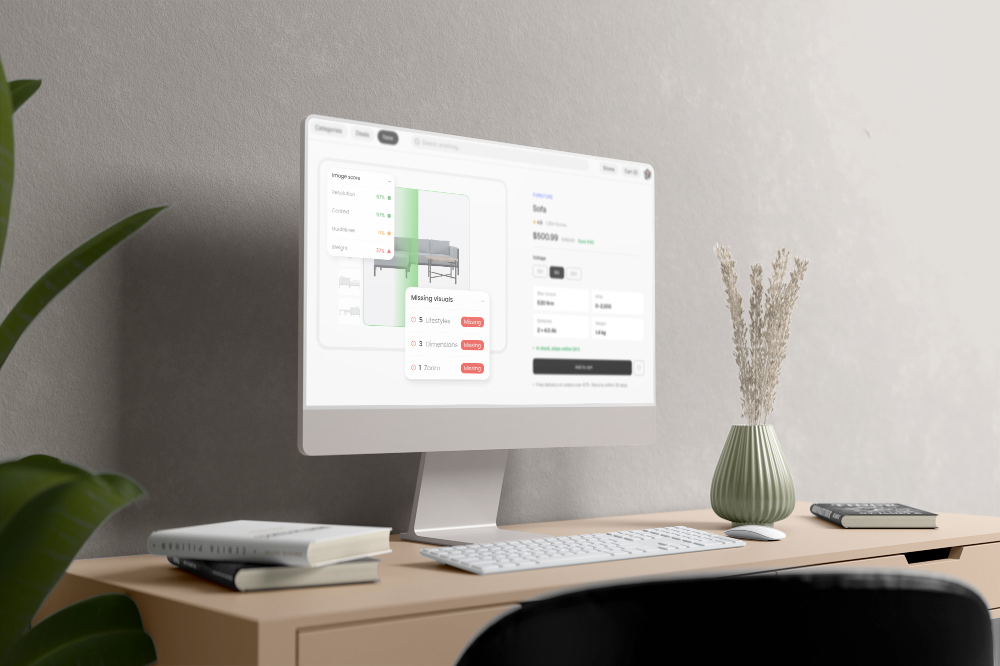
- Measure visual content across the shelf, from image count and required views to variant coverage and consistency, by category and by vendor.
- Benchmark against competitors, to see where rival pages show more than yours. Turn visual standards into Vendor Scorecards, so each vendor knows exactly which images are missing or wrong on its own pages.
- Close the gaps at scale: vendors create the missing visuals with Nfinite or fix them on their own in self-service.
The retailer gets a shelf that's ready for shoppers and agents alike. Brands get the same view from the other side: how their visuals hold up at every retailer they sell through, and what to fix first.
How agent-ready is your shelf today? Book a demo of Nfinite to see what agents miss on your product pages.
Sources
- BCG, How Retailers Can Reinvent the Digital Flywheel for Agentic Commerce, October 21, 2026. Survey of 50 of the top 300 global retailers and 100 global brands.
- ECDB, Agentic Commerce and AI in E-Commerce, ECDB Perspective, 2026. Conversion data based on Adobe and Similarweb; zero-click data based on Semrush and SparkToro. Agentic Commerce & AI in E-Commerce 2026
- BCG, Are CPG Companies Ready for Agentic Commerce?, October 30, 2026.
Insights in your inbox
Is your product page agent-ready? What BCG's research says, and the part it leaves out: your photos

Q2 2023
Dynamic Display
With Dynamic Display, shoppers easily mix and match multiple products in real-time — and shop directly from the experience. Retailers can seamlessly embed this on their websites and apps, showcasing these shoppable showrooms wherever they do business online.
Search and tag visuals
Users can now search visuals on the platform! Instead of scrolling through visuals or looking up product or template details, users can easily find visuals using keywords and filters. Filters include visual type, products, organizations, creators, status, and creation date. And now, with the ability to tag visuals, users can also search by tag.
Advanced template search takes this a step further. When users begin creating a visual by selecting a product, in addition to seeing all compatible templates, they can now search for specific templates using a variety of filters, including categories, ratios, tags, and more.

Enhanced scene creation
Our redesigned scene editor offers a more immersive editing canvas while providing a simpler, easy-to-learn, and more intuitive UI. Users can swap products, repaint walls — and ultimately create scenes — faster than ever.
Vastly improved swap diversity
We've rebuilt how product swaps work to allow users to browse and swap any product with the accurate geometry. Gone are the limitations of a single or select group of product categories, enabling users to leverage their creativity by quickly transforming a bedroom into a home office or a garage into a home gym.
Preview Visuals Within Email Notifications
Each email notifying you about a new packshot, 360, or lifestyle will include a beautiful preview image helping you maintain context and make more informed decisions.

Control Your 360° spins
Customize your 360° spins by editing the duration, manipulating the zoom, or changing the camera angle to your exact specifications.
Want to get a full tour of the product? Request a demo today!
Related content


Insights in your inbox
Stay up to date


